PRE-MODERN 1800 - 1880 AD (CE)
Neo-Classicism 1750 - 1880 AD
(USA: Federal/Greek Revival)
(Canada: Georgian Style)
"In painting it generally took the form of an emphasis on austere linear design in the
depiction of classical themes and subject matter, using archaeologically
correct settings and costumes."
http://lilt.ilstu.edu/jhreid/neoclassicism.htm
Romanticism 1800 - 1880 AD
(Canada: Victorian)
"With its emphasis on the imagination and emotion, Romanticism emerged as a response to the disillusionment with the Enlightenment values of reason and order in the aftermath of the French Revolution of 1789... [The] blurring of stylistic boundaries is best expressed in Ingres'
Apotheosis of Homer and Eugène Delacroix's
Death of Sardanapalus (both Museé du Louvre, Paris), which polarized the public at
the Salon of 1827 in Paris. While Ingres' work seemingly embodied the ordered classicism of the David in contrast to the disorder and tumult of the Delacroix, in fact both works draw from the Davidian tradition but each ultimately subverts that model, asserting the originality of the artist—a central notion of Romanticism"
http://www.metmuseum.org/toah/hd/roma/hd_roma.htm
Realism 1830's - 1850's AD
"Realism - the accurate and apparently objective description of the ordinary, observable world, a change especially evident in painting ... Realism sets as a goal not imitating past artistic achievements but the truthful and accurate depiction of the models that nature and contemporary life offer to the artist. The artificiality of both the Classicism and Romanticism in the academic art was unanimously rejected, and necessity to introduce contemporary to art found strong support."
http://www.huntfor.com/arthistory/c19th/realism.htm
Impressionism 1870's - 1890's AD
"Impressionist art is a style in which the artist captures the image of an object as someone would see it if they just caught a glimpse of it. They paint the pictures with a lot of color and most of their pictures are outdoor scenes. Their pictures are very bright and vibrant. The artists like to capture their images without detail but with bold colors. Some of the greatest impressionist artists were Edouard Manet, Camille Pissaro, Edgar Degas, Alfred Sisley, Claude Monet, Berthe Morisot and Pierre Auguste Renoir."
http://www.cs.ucf.edu/~MidLink/Impress.html
MODERNISM 1880 - 1945 AD (CE)
Post Impressionism 1880 - 1900 AD
"The term "Post-Impressionism" was invented by Roger Fry as he prepared for an exhibition at Grafton Gallery in London in 1910. The show was called "Manet and the Post-Impressionists" (November 8, 1910-January 15, 1911), a canny marketing ploy to pair a brand name with younger French artists whose work was not well known on the other side of the English Channel.The exhibition included the painters Vincent van Gogh, Paul Cézanne, Paul Gauguin, George Seurat, André Derain, Maurice de Vlaminck and Othon Friesz, plus the sculptor Aristide Maillol. Post-Impressionists pushed the ideas of the Impressionists into new directions, their modernist journey from the past into the future."
http://arthistory.about.com/od/modernarthistory/a/Post-Impressionism-Art-History-101-Basics.htm
Expressionism 1900 - 1920 AD
"Expressionism is an artistic style in which the artist attempts to depict not objective reality but rather the subjective emotions and responses that objects and events arouse in him. He accomplishes his aim through distortion, exaggeration, primitivism, and fantasy and through the vivid, jarring, violent, or dynamic application of formal elements. In a broader sense Expressionism is one of the main currents of art in the later 19th and the 20th centuries, and its qualities of highly subjective, personal, spontaneous self-expression are typical of a wide range of modern artists and art movements."
http://www.artmovements.co.uk/expressionism.htm
Fauvism 1900 - 1920 AD
"Fauvism is a movement in French painting that revolutionized the concept of color in modern art. Fauves earned their name ("les fauves"-wild beasts) by shocking exhibit visitors on their first public appearance, in 1905. At the end of the nineteenth century, neo Impressionist painters were already using pure colors, but they applied those colors to their canvases in small strokes. The fauves rejected the impressionist palette of soft, shimmering tones in favor of radical new style, full of violent color and bold distortions"
http://www.huntfor.com/arthistory/C20th/fauvism.htm
Cubism 1907 - 1914 AD
"Cubism was a truly revolutionary style of modern art developed by Pablo Picasso and Georges Braque. It was the first style of abstract art which evolved at the beginning of the 20th century in response to a world that was changing with unprecedented speed. Cubism was an attempt by artists to revitalise the tired traditions of Western art which they believed had run their course.
In the four decades from 1870-1910, western society witnessed more technological progress than in the previous four centuries. During this period inventions such as photography, cinematography, sound recording, the telephone, the motor car and the airplane heralded the dawn of a new age. Artists needed a more radical approach - a 'new way of seeing' that expanded the possibilities of art in the same way that technology was extending the boundaries of communication and travel. This new way of seeing was called Cubism - the first abstract style of modern art. Picasso and Braque developed their ideas on Cubism around 1907 in Paris and their starting point was a common interest in the later paintings of Paul Cézanne."
Dada 1916 - 1922 AD
"Overall, Dada artworks present an intriguing paradox in that they seek to demystify artwork in the populist sense but nevertheless remain cryptic enough to allow the viewer to interpret works in a variety of ways. Like the Cubists, some Dadaists portrayed people and scenes representationally in order to analyze form and movement. Other artists, like Kurt Schwitters, practiced abstraction to express the metaphysical essence of their subject matter. Both modes sought to deconstruct daily experience in challenging, rebellious ways. Key to understanding Dada works lies in reconciling the seemingly silly, slapdash styles with the stringent anti-war message. Tristan Tzara especially fought the assumption that Dada was a statement; yet Tzara and his fellow artists became increasingly agitated by politics and sought to incite a similar fury in Dada audiences."
http://www.theartstory.org/movement-dada.htm
Bauhaus 1920s - 1940's AD
"The Bauhaus is one of the first colleges of design. It came into being from the merger of the Weimar Academy of Arts and the Weimar School of Arts and Crafts. It was founded by Walter Gropius in 1919 and was closed in 1933 by the Nazis.
"The Bauhaus holds a place of its own in the culture and visual art history of 20th century. This outstanding school affirmed innovative training methods and also created a place of production and a focus of international debate. It brought together a number of the most outstanding contemporary architects and artists. The Bauhaus stood almost alone in attempt to achieve reconciliation between the aesthetics of design and the more commercial demands of industrial mass production.
"The teaching program was organized in the form of workshops to produce works that were both aesthetically pleasing and useful. The creed of this program asserted that the modernization process could be mastered by means of design. As a result, in 1923 the Bauhaus turned it attention to industry. The first major Bauhaus exhibition which was opened in 1923 reflected the revised principle of art and technology a new unity spanned the full spectrum of Bauhaus work. It was Art and Technology, a New Unity, which was also the name of the workshop in which the art was created. "
http://www.huntfor.com/arthistory/C20th/bauhaus.htm
Surrealism 1924 1920s - 1940's AD
"The main aim of Surrealism Art is to make drastic reductions on the role played by consciousness and intervention of will. Max Ernst used collage and frottage techniques to further the cause of Surrealism Art while André Masson experimented with automatic drawings. Man Ray and his famous Rayographs, Dalí, Magritte, and Miró who produced oneiric images that sought to cause a juxtaposition of disparate elements were other, highly influential members of the Surrealism Art movement."
http://surrealismart.org/
MODERN & POST-MODERN 1945 AD - Present (CE)
Abstract Expressionism 1945 - 1960 AD
"Emerging in the 1940s in New York City and flourishing in the Fifties, Abstract Expressionism is regarded by many as the golden age of American art. The movement is marked by its use of brushstrokes and texture, the embracing of chance and the frequently massive canvases, all employed to convey powerful emotions through the glorification of the act of painting itself.
Some of the key figures of the movement were Jackson Pollock, Mark Rothko, Willem de Kooning, Robert Motherwell and Franz Kline. Although their works vary greatly in style, for example the sprawling pieces of Pollock at one end of the spectrum and the brooding works of Rothko at the other, yet they all share the same outlook which is one of freedom of individual expression."
http://www.artmovements.co.uk/abstractexpressionism.htm
Pop Art 1960s AD
"The term first appeared in Britain during the 1950s and referred to the interest of a number of artists in the images of mass media, advertising, comics and consumer products. Influenced by the art seen in Eduardo Paolozzi's 1953 exhibition
Parallel between Art and Life at the Institute for Contemporary Arts, and by American artists such as Jasper Johns and Robert Rauschenberg, British artists such as Richard Hamilton and the Independent Group aimed at broadening taste into more popular, less academic art. Hamilton helped organize the 'Man, Machine, and Motion' exhibition in 1955, and 'This is Tomorrow' with its landmark image
Just What is it that makes today's home so different, so appealing? (1956). Pop Art therefore coincided with the youth and pop music phenomenon of the 1950s and '60s, and became very much a part of the image of fashionable, 'swinging' London. Peter Blake, for example, designed album covers for Elvis Presley and the Beatles and placed film stars such as Brigitte Bardot in his pictures in the same way that Warhol was immortalizing Marilyn Monroe in the USA. Pop art came in a number of waves, but all its adherents - Joe Trilson, Richard Smith, Peter Phillips, David Hockney and R.B. Kitaj - shared some interest in the urban, consumer, modern experience."
The Bulfinch Guide to Art History


 Minimal Art 1960s AD
"Minimal art was an artistic style, which emerged in America the late 1950s. The term was taken from an essay about modern American art by art philosopher Richard Wollheim in 1965. Hard Edge and Colour Field Painting tendencies were an important pre-requisite for the development of this style, as they had essentially prepared the ground for the use of very simple, reduced minimal forms. Minimal Art first established itself in painting, and then sculpture, where it had the greatest impact.
Minimal Art 1960s AD
"Minimal art was an artistic style, which emerged in America the late 1950s. The term was taken from an essay about modern American art by art philosopher Richard Wollheim in 1965. Hard Edge and Colour Field Painting tendencies were an important pre-requisite for the development of this style, as they had essentially prepared the ground for the use of very simple, reduced minimal forms. Minimal Art first established itself in painting, and then sculpture, where it had the greatest impact.
Minimal art sculptures were primarily made from industrial materials, such as aluminium, steel, glass, concrete, wood, plastic or stone. The objects, frequently reduced to very simple geometric shapes, were industrially produced, thus removing the artist’s personal signature from the work. The works were also characterised by serial arrangements of a number of bodies/shapes, and large dimensions"
http://www.kettererkunst.com/dict/minimal-art.shtml
 http://www.arthistoryguide.com/

 Renoir started life as a poor working class boy, working as a porcelain painter in a factory - a job that was intense and delicate - good grounding for the work he would later do.

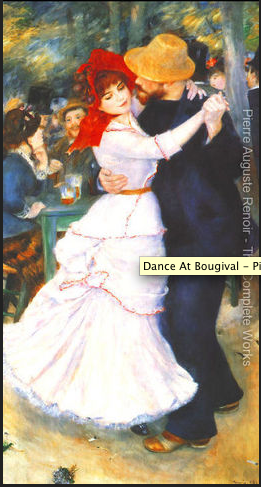


 The painting shows a dancing couple, captured in a moment of joy. The canvas is tall and thin, almost clinging to the dancers, as if making them the most important people in the world - which they may have felt like at the time; there is also very little in the frame besides the dancers, adding to this feeling. The colours of the clothes may represent a sort of Yin and Yang of the relationship they may be having; he wears a dark suit, she has a light frilly dress.


